
Recess, Reconciliation Realignment, and Red Snapper
Roundup: May 18 – May 26, 2026


This Memorial Day, we honor and remember those who gave their lives in service to our country.
Who’s in session this week?
Both chambers are in recess for Memorial Day.
Make sure you have the ESP Advisors printable 2026 Congressional Calendar and our public Congressional Google Calendar (updated live) at your fingertips.
News Highlights
The Trump Administration’s effort to expand recreational fishing opportunities for Red Snapper in the southeast was temporarily blocked in court amid challenges from commercial fishermen over adherence to the Magnuson-Stevens Act.
NOAA and the Cook Islands Seabed Minerals Authority announced a summer expedition to map and explore deep-sea habitats and critical mineral-rich polymetallic nodules in the Cook Islands’ waters, highlighting growing international interest in seabed mineral resources.
The House Appropriations Committee approved its FY27 Energy and Water Development spending bill last week. The bill would fund the Department of Energy and the Army Corps of Engineers. Only five of the twelve annual appropriations bills are still awaiting full committee consideration in June.

Congress is in recess this week after Republicans failed to move forward on their reconciliation package that would fund Immigration and Customs Enforcement (ICE) and Customs and Border Patrol (CBP) amid internal divisions over executive authority and oversight. At this rate, they will not meet President Trump’s requested deadline of June 1. ICE and CBP remain unfunded via regular order appropriations.
This reflects a moment. Some Senate Republicans appear increasingly uneasy with the administration amid concerns about executive authority and election-year politics. The issues last week highlighted widening fractures between congressional Republicans and the administration as lawmakers head toward a packed summer agenda.
Meanwhile, the House Appropriations Committee continued to mark up their bills, leaving only five remaining to be considered by the full committee in June. Check out our annual appropriations bill tracker here (updated weekly).
On the Campaign Trail
Texas heads into consequential primary runoffs today, including a record-breaking Republican Senate contest between longtime Sen. John Cornyn (R-TX) and Texas Attorney General Ken Paxton that is already reshaping the 2026 map — and could ultimately become one of the most expensive Senate primary races in history. Trump endorsed Paxton last week.
Executive Branch News
At the White House, Vice President JD Vance is convening Republican attorneys general around the administration’s anti-fraud agenda as partisan tensions continue to deepen across federal agencies and Congress. NASA is unveiling updates to its long-term “Moon Base” strategy this week, which is an initiative to build a permanent, nuclear-powered outpost at the lunar South Pole by 2036.
One of the more politically charged ocean stories over the holiday weekend centered on South Atlantic red snapper fishing access. Earlier this month, the Trump Administration expanded recreational fishing opportunities through exempted fishing permits (EFPs) for Florida, Georgia, South Carolina, and North Carolina, arguing the move would return management flexibility and access to anglers frustrated by federal restrictions. But a federal judge temporarily halted the program on Thursday last week following a legal challenge from commercial fishermen, who argued the permits bypassed established science-based management processes under the Magnuson-Stevens Act. Environmental groups supported the legal challenge from commercial fishermen by filing amicus briefs. Trump posted over the weekend in support of expanded fishing access and criticizing the courts for opposing the effort.

None this week.

Introductions
Reps. Tim Walberg (R-MI-05) and Sarah Elfreth (D-MD-03) introduced the Aquatic Invasive Species Control and Prevention Act (H.R.8876). The bill would amend the Nonindigenous Aquatic Nuisance Prevention and Control Act of 1990 to update federal authorities related to the prevention, management, control, and eradication of aquatic nuisance species.
Rep. John Moolenaar (R-MI-02) introduced a bill which would prohibit certain federally funded research collaborations with designated foreign entities (H.R.8901). The bill would restrict federal research partnerships involving entities deemed to pose national security concerns.
Del. Aumua Amata Coleman Radewagen (R-AS-AL) introduced a bill to amend the Magnuson-Stevens Fishery Conservation and Management Act to address the regulation of fishing activities in marine national monuments (H.R.8904). The bill would clarify federal fisheries management authority within marine national monument boundaries.
Sen. Gary Peters (D-MI) and Bernie Moreno (R-OH) introduced a bipartisan bill which would designate the Great Lakes Commission as a Regional Great Lakes Partnership (S.4573). The bill would formally recognize the Commission’s role in coordinating regional collaboration and policy efforts across the Great Lakes region.
Rep. Don Beyer (D-VA-08) introduced the Protect Gulf Life Act (H.R.8919). The bill would overturn a 2026 federal decision that exempted Gulf oil and gas operations from certain Endangered Species Act protections, restore those environmental safeguards for at least three years, and prevent federal agencies from reissuing similar exemptions during that period in order to better protect endangered marine species and Gulf ecosystems.
Sens. Adam Schiff (D-CA) and Alex Padilla (D-CA) introduced the Golden Mussel Eradication and Control Act of 2026 (S.4603). The bill would establish a federally funded program to prevent, monitor, and combat the spread of invasive golden mussels in California waterways by supporting early detection, research, infrastructure protection, and grants for state and local response efforts.
Updates
Rep. Daniel Webster’s (R-FL-11) Florida Safe Seas Act of 2025 (H.R.3831) was reported out of the House Committee on Natural Resources. The bill would amend the Magnuson-Stevens Fishery Conservation and Management Act to prohibit shark feeding activities in the exclusive economic zone off the coast of Florida.
Rep. Suzanne Bonamici’s (D-OR-01) Water Power Research and Development Reauthorization Act (H.R.7129) was marked up and reported out of the House Committee on Science, Space, and Technology. The bill would reauthorize and expand federal water power research and development programs through FY30, including support for marine energy, hydropower, workforce development, advanced manufacturing, grid resilience, and next-generation testing infrastructure.


Administration
President Trump released a National Maritime Day message honoring U.S. Merchant Mariners and highlighting the Administration’s efforts to expand domestic shipbuilding capacity and invest in U.S. port and maritime infrastructure.
Personnel
The Senate confirmed a number of President Trump’s nominees last week in a 46-43 vote. The nominees included:
Wesley Brooks to be Assistant Secretary of State for Oceans and International Environmental and Scientific Affairs (currently Deputy Administrator for Regulatory and Scientific Affairs at EPA’s Office of Water)
Steven Haines to be an Assistant Secretary of Commerce
Arvind Raman to be Under Secretary of Commerce for Standards and Technology
Matthew Anderson to be Deputy Administrator of the National Aeronautics and Space Administration
Seval Oz and Daniel Edwards to be Assistant Secretaries of Transportation
Robert Harvey to be a Federal Maritime Commissioner
Former Rep. Steve Pearce (R-NM-02) (2003–2009 and 2011–2019) to be Director of the Bureau of Land Management
The Department of Energy announced leadership changes, including the Senate confirmation and swearing-in of Kyle Haustveit as Under Secretary of Energy, and the appointment of Alex Fitzsimmons as Associate Deputy Secretary of Energy and Senior Advisor to the Secretary.
Rep. Thomas Massie (R-KY-04) filed paperwork to run for federal office in 2028, days after falling to advance in the Republican primary against a Trump-backed challenger, though he has not yet announced which office he plans to seek.
NASA announced an agencywide realignment that restructures several mission directorates and leadership roles, including new leadership appointments at Goddard Space Flight Center, Kennedy Space Center, and the Glenn Research Center. This realignment aims to support priorities outlined in the Trump Administration’s National Space Policy, including the Artemis program, lunar exploration, nuclear propulsion, and commercial space development.
Congressional Oversight
Sens. Sheldon Whitehouse (D-RI), Jeff Merkley (D-OR), and 39 other Senate Democrats sent a letter urging Senate appropriators to exclude any controversial, anti-environment policy riders from FY27 spending bills, citing House proposals targeting protections for air and water quality, public lands, and other environmental safeguards.
Sen. Susan Collins (R-ME), Chair of the Senate Appropriations Committee, raised concerns about proposed reductions in Navy ship procurement and warned about potential impacts on the U.S. shipbuilding industrial base and fleet readiness.
Sen. Patty Murray (D-WA), Vice Chair of the Senate Appropriations Committee, criticized the Trump Administration’s proposed FY27 budget cuts for the Army Corps of Engineers and Bureau of Reclamation, warning the reductions could affect water infrastructure, flood control, and port projects as Bipartisan Infrastructure Law funding expires later this year.
House Science, Space, and Technology Committee Chair Brian Babin (R-TX-36) and Oversight Subcommittee Chair Rich McCormick (R-GA-07) sent a letter requesting a NOAA briefing on the agency’s oversight of marine cloud brightening and other geoengineering research, citing concerns about transparency, environmental risks, and implementation of recommendations from a recent Government Accountability Office (GAO) report on weather modification oversight.
Fisheries and Ecosystems
The Florida Fish and Wildlife Conservation Commission announced it will allow fishing for Red Snapper in state waters in response to a federal court issuing a temporary injunction on NOAA’s plan to open the fishing season in federal waters.
NOAA Fisheries’ Office of Habitat Conservation highlighted the completion of a decades-long restoration effort on California’s Alameda Creek that reopened migratory fish passage for threatened steelhead and Chinook salmon after crews removed the final major barrier blocking access to upstream spawning habitat.
The Department of the Interior announced more than $67 million in funding for wetland conservation and national wildlife refuge projects, including grants through the North American Wetlands Conservation Act to conserve or restore more than 190,000 acres of habitat for migratory birds.
Ocean Science and Technology
NOAA predicted a below-normal 2026 Atlantic hurricane season, forecasting 8–14 named storms and citing the expected development of El Niño as a key factor likely to suppress hurricane activity.
NOAA Research announced new hurricane forecasting efforts for the 2026 Atlantic hurricane season, including expanded use of artificial intelligence, upgraded forecast models, uncrewed aircraft and ocean drones, and additional Hurricane Hunter data collection to improve storm intensity and track forecasts.
Offshore Energy and Minerals
NOAA announced that the agency, in partnership with the Cook Islands Seabed Minerals Authority, will conduct a 28-day summer expedition aboard NOAA Ship Okeanos Explorer to map, explore, and characterize deep waters and seabed habitats off the Cook Islands, including areas containing polymetallic nodules with critical minerals such as nickel, cobalt, and manganese.
The Department of Energy’s Hydropower and Hydrokinetic Office (H2O) announced the winners of the 2026 Marine Energy Collegiate Competition, with the University of Southern California taking the overall top prize for student-designed marine energy technologies and coastal energy solutions.

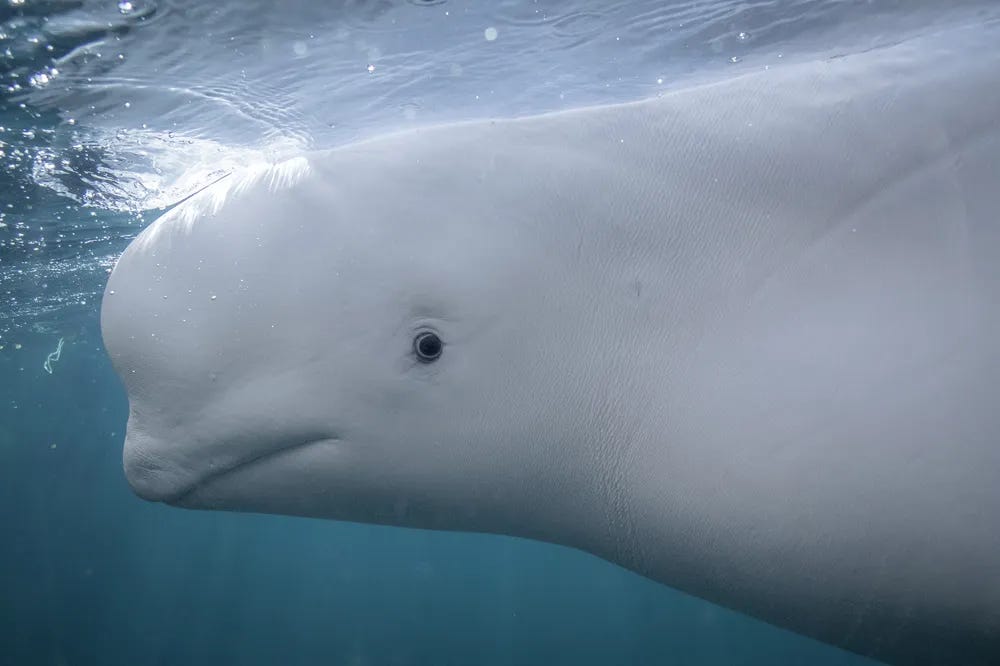
Beluga whales just joined one of the most exclusive clubs on Earth! In a new study published in PLOS One, researchers at the New York Aquarium found that two belugas showed signs of mirror self-recognition, a rare cognitive ability shared by humans, great apes, dolphins, elephants, and only a handful of other animals. Researchers installed a two-way mirror in the whales’ pool and observed how the belugas reacted to their reflections over multiple sessions. One whale, Natasha, even passed the classic “mark test” by using the mirror to inspect a hidden mark placed on her body. Belugas are known for their intricate communication systems and strong social bonds, and the findings offer researchers another step toward understanding advanced cognition and self-awareness in marine mammals.